
By Robert “Bobby” Ives
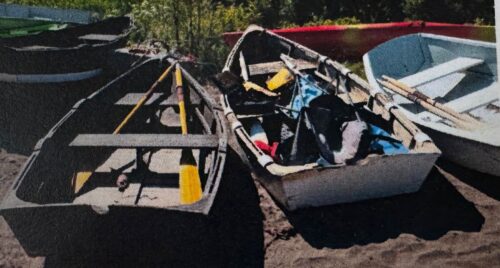
I first laid eyes on a Monhegan Skiff more than fifty years ago. In 1973, my wife Ruth and I moved out to Monhegan Island to become the teachers at the one-room school and the ministers of the island’s Community Church. In our first walk around the island, we were spellbound by the drama of the cliffs. the sanctity of Cathedral Woods, the majesty of Light House Hill. Equally beautiful to me was the assortment of Monhegan skiffs adorning Fish Beach. The island’s fishermen used their rugged little “donkeys of the sea” to row from the rocky shore to their lobster boats moored in the notoriously difficult waters of the island’s harbor. The skiffs were–and still are–vital to Monhegan’s daily, maritime life. I had no idea they would he the genesis of my future vocation, nor that my life and Monhegan skiffs would be entwined for more than half a century.
After living on Monhegan and, later, on Louds Island in Muscongus Bay, we moved a few miles inland in 1979 and founded The Carpenters’ Boat Shop to launch an apprenticeship program in Pemaquid, Maine. We dedicated the enterprise to building boats, nurturing lives and helping others. To this day, the Boat Shop offers its apprentices an opportunity to pause in the midst of life’s transitions and challenges. Wherever apprentices are from, wherever they may be headed, the Boat Shop provides a harbor In which to drop anchor before setting sail on a new course in life.
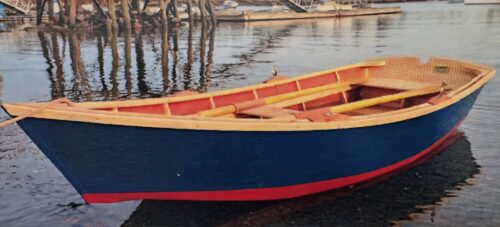
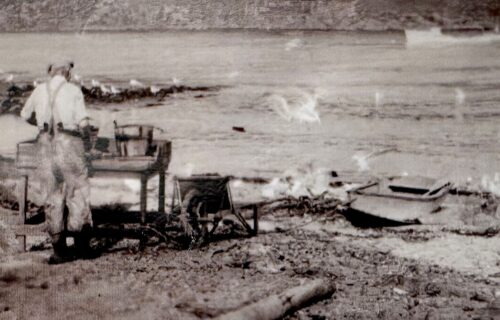

The Carpenter’s Boat Shop and its apprentices have built many kinds of boats over the years: dories, peapods, sailboats, and dinghies in many shapes and sizes. But one vessel remains at its core: the Monhegan Skiff. Each apprentice class builds skiffs, not only for the Monhegan fishermen, but for people throughout the United States.
Will Stanley Jr., a carpenter and boatbuilder on the island, designed the flat-bottomed skiff specifically for the conditions faced by Monhegan’s fishermen, who needed a sturdy, seaworthy, craft that could be rowed through choppy waters from the center seat or from one in the bow if carrying a sternman or barrel of bait. Will Stanley was a teenager when he arrived on Monhegan with his father in 1883, but he didn’t remain there long. The senior William S. Stanley had just been promoted to keeper of the light on the island, but he realized that his son would have little opportunity to learn a craft on the sparsely populated island off Maine’s Pemaquid Peninsula. Will Stanley Sr. had spent the previous year as assistant keeper of the light on Mr. Desert Rock, 21 miles out in the Gulf of Maine from Mt. Desert Island. He knew Will Jr. would learn more and be better prepared for a productive and meaningful life if he learned carpentry and woodworking where such crafts were in greater demand.
In the 1880s, Bar Harbor and Mt. Desert Island were popular vacation spots for families that amassed great fortunes in the preceding decade dubbed the “Gilded Age.” The Rockefellers, Morgans, Fords, Vanderbilts, Carnegies, and Astors were transforming the landscape of Mount Desert Island, building elegant estates and great mansions that offered a superb opportunity for young Will to learn carpentry. He returned to Monhegan with his wife, Minnie Fernald, of Manset, in the 1890s to become the island’s principal carpenter. He and Minnie had five children: Dwight, Abbie, Henry, Banes, and Charlotte. For more than 50 years, Will Jr. built some of the most distinguished structures on the island, including the Island Inn, the Monhegan Memorial Library, and his own home in 1903.
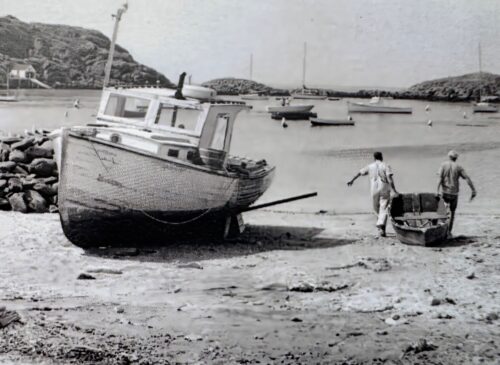
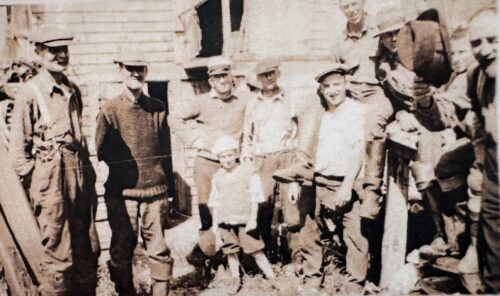
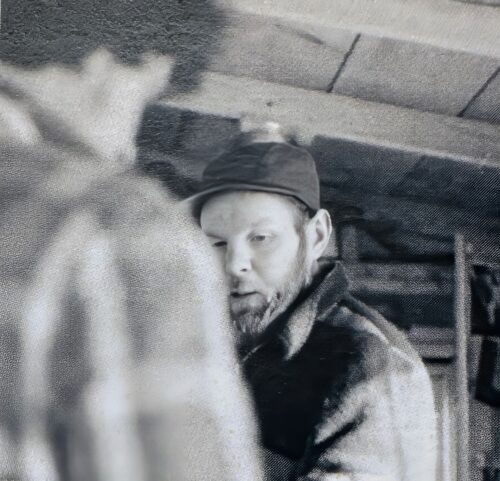
Early in the 20th century, Will also designed and built a skiff for the Monhegan Island fishermen to row from the shore to their lobster boats moored in the harbor. In earlier days the Monhegan fishermen had used dories, punts, or small, flat-bottomed, three-planked vessels they called “choppers.” Will’s new design, however, proved better suited to the rough conditions unique to the island. It was a 9 1/2 foot skiff that was cross planked with 11 inches of rocker on the bottom that made it easier to push off and land on the shore, and far easier to drag on the stony beach, where there is no dock.
The bottom planks were cedar to resist rot and the stem, sides, and transom were pine, which was lightweight and inexpensive. The boat featured a sculling hole in the transom that enabled a skilled oarsman to propel the vessel with a single arm and oar. Hard oak skids on the perimeter and center of the bottom enabled the boat to be dragged up and down the shore without hurting the bottom. The skiff was remarkably seaworthy, rowed well, and handled ably in the rough waters common in the harbor, where strong winds and currents present daily challenges. Within a few years, Will Stanley’s skiff was the vessel of choice for many of the fishermen and remains so more than I 00 years later.
Will Jr. made skiffs for many decades, and his son Banes (Mardell Banes Stanley (1913-1969) continued in Will’s footsteps as a carpenter and a boat builder for the fishermen.
In the 1960s, Banes’s son Ronnie carried on the Stanley tradition, building boats with his father, and then taking over the responsibility after Banes died in 1969.
Over the years, Will Jr.’s original design underwent some changes. After World War II, as plywood became more abundant, Ronnie began using it to make the sides of the boat, substituting considerably lighter 1/4-inch plywood for the heavier ¾-inch pine sides in the original design. He also added a longer, 11 ½-foot version of the skiff. Ronnie built the skiffs from the 1960s until his diabetes and resulting blindness left him unable to continue. In 1979, just as we were starting The Carpenter’s Boat Shop, Ronnie asked if we would be willing to build Monhegan Skiffs for the fishermen when they needed them. Ronnie knew I had built two peapods–small, doubleended rowing and sailing boats–the first with the help of Edward Salor, a Norwegian immigrant and master boatbuilder. Salor taught me to work with hand tools alone because Louds Island, where Ruth and I were living, had no electricity. Having made two more boats as we were starting The Carpenter’s Boat Shop, I told Ronnie I would be honored to take on the skiff project and went out to Monhegan to visit him in his small shed/boat shop. He gave me his plans and a bevel board that contained all the angles, bevels, and dimensions for the 9 ½-foot and 11 ½-foor skiffs.
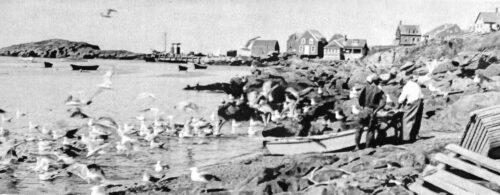
The Carpenter’s Boat Shop has since built well over 200 Monhegan Skiffs, and every year, new apprentices learn the demanding skills of building boats beginning with the little rowboats. It has been a privilege to keep the tradition alive. And although the boats were originally built for one small island’s fishermen, they now have made their way to all parts of America.
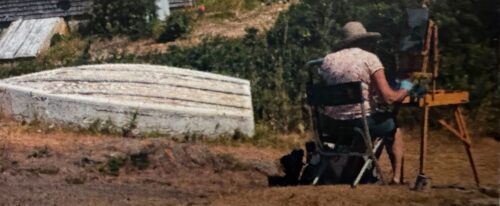
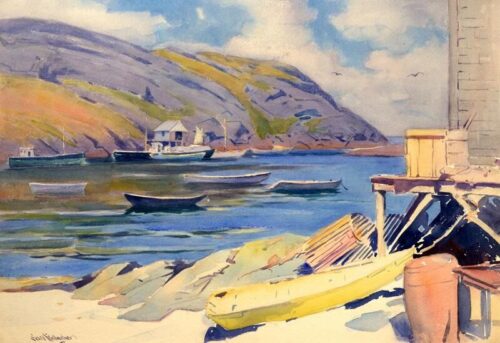
The fame of the little Monhegan Skiff has also been promulgated and spread by the innumerable artists who have painted or photographed the worthy vessels during the last century. Although the origins of the art community on Monhegan go back to the mid 19th century, it was Robert Henri, the spiritual father of the Ashcan School of Art in Manhattan, who first painted many of the boats on the island in the early years of the 20th century. His associates and other distinguished artists painted the working watercraft during Monhegan’s own Golden Age between the 1920s and World War II, and depicting the skiffs became a tradition of its own. Edward Hopper, Eric Hudson, Scars Gallagher, Leo Meissner, and Abraham Bogdanove are just a few of the artists whose works include the readily recognizable Monhegan Skiff.
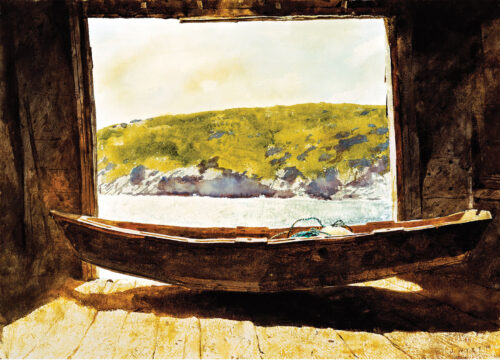
Perhaps none of the artists is better known today than the contemporary painter, Jamie Wyeth, who purchased a Monhegan Skiff from The Carpenter’s Boat Shop in the early 1980s. The son and grandson of famous artists, Jamie has lived and painted on Monhegan and nearby islands for more than 50 years, and his 1984 watercolor, Monhegan Skiff now belongs to the Farnsworth Museum in Rockland, Maine. Jamie’s longtime support of The Carpenter’s Boat Shop has earned him the gratitude of staff and apprentices for decades.
© 2025 Robert Ives & The Carpenter’s Boat Shop